How do you handle grade disputes in the AI era?
We are academics who built the AI platform we wished we had.
When AI changed what students submit, institutions were left with no reliable way to defend their academic decisions. Sapheos makes those decisions traceable, defensible, and auditable.
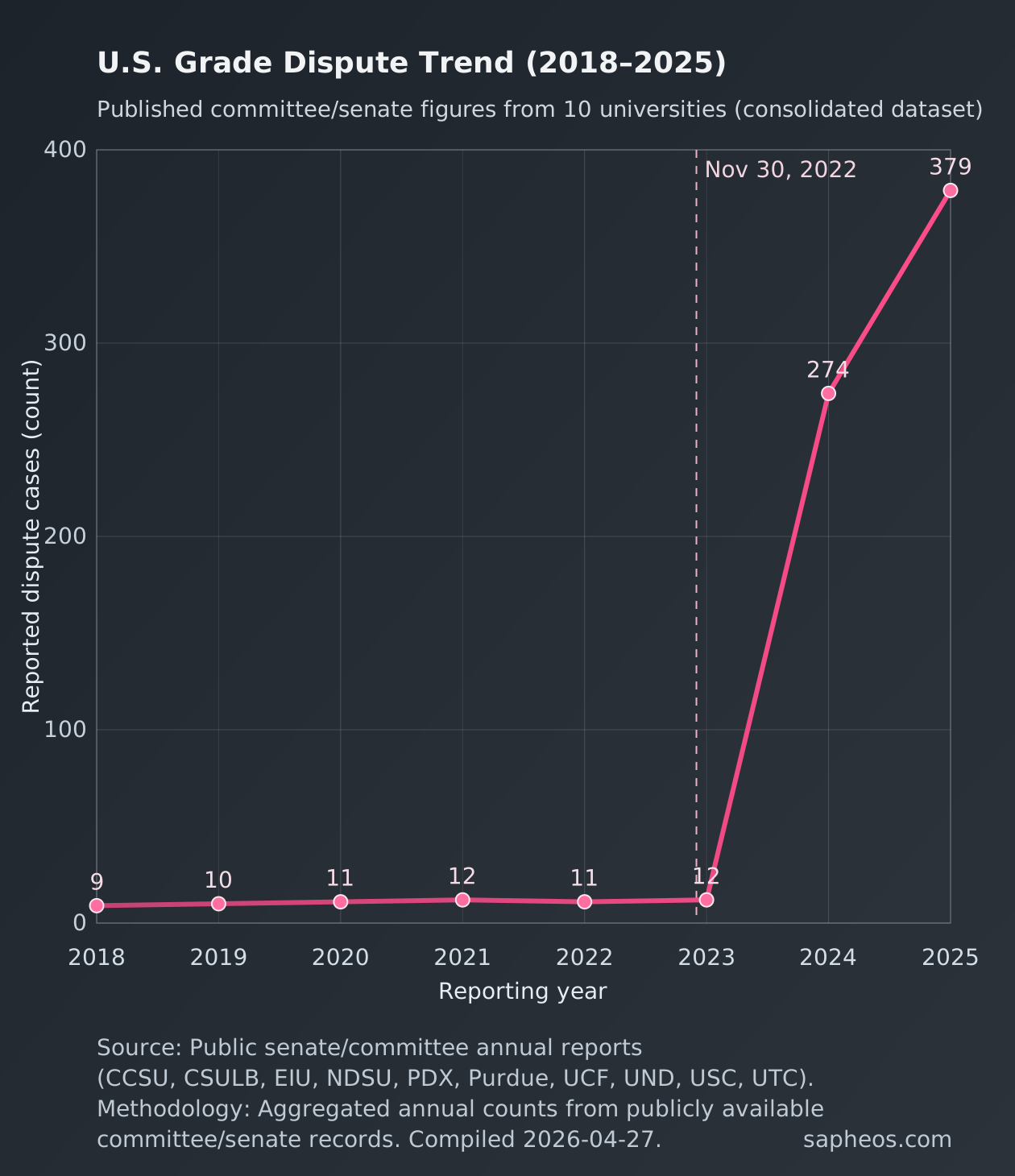
Grade disputes are universally on the rise.
Published committee and senate figures from ten US universities. The line was flat for five years. Then it wasn't.
An AI report telling the student the institution's grade is wrong
Perceived unfair evaluation against peers
Insufficient support, advice or supervision
False positives from existing AI detection tools
A record that answers the five questions an appeal actually asks.
Sapheos runs quietly alongside the real work of a dissertation, a capstone or a semester-long project, capturing process rather than policing output. It integrates into your existing LMS.
Your students' high-stakes work: dissertations, capstones, research projects.
A detailed, justified report answering each question below, on the record, before anyone challenges a grade.
We report the evaluation in accordance with your programme's guidelines and standards.
Each rubric is justified, followed by a 1,200-word reviewer's report detailing how the assessment was made.
We analyse linguistic patterns, cognitive depth and argumentative construction across the submission.
We document human grounding and AI use within the work.
We question each student before writing, to define the topic, the research question and the argument.
You receive records of every interaction between the student and AI.
We check every cited source against verified databases.
We document non-existent references, incorrect citations, and sources that are likely fabricated.
We connect the student's decisions, trade-offs and actions in internships or projects to your programme's stated outcomes.
Each competency is assessed independently, followed by a report detailing how they intertwine.
It sits underneath what you already do
Sapheos is designed to sit underneath your existing academic-integrity process, not replace it. It integrates into your LMS on the LTI 1.3 standard, with institutional single sign-on.
It records reasoning, it does not make the call
The record documents supervision as it happens rather than reconstructing it after a complaint. The evidence supports the supervisor's judgment; it does not replace it.
The same standard, visibly applied
Each student is questioned before writing, to define the topic, the research question and the argument. The standard applied to their work is the one applied to everyone else's.
Four people are in the room when a grade, or a dispute, is decided.
Select the one that describes you.

Needs a system that scales across the institution without adding legal or reputational risk to every academic-integrity case.
What you're facing
- Increased costs relating to escalation in grade disputes
- Risk of losing accreditations and declining in rankings
- Reputational risk
What Sapheos gives you
- An infrastructure for quality assurance
- Stakeholder satisfaction
- Cost control across the dispute process

Needs a defensible standard applied consistently across every programme, every cohort, every dispute, long after any one jury dissolves.
What you're facing
- Claims that AI told students their work was worth a better grade than the one awarded
- Claims that supervision and advice from the supervisor were not sufficient
- Complaints that other students received better grades for comparable work
What Sapheos gives you
- Evaluation standardisation within the programme, minimising unfair-treatment claims
- Supervision virtualisation and standardisation, reducing insufficient-support claims
- Traceable records for supervision and evaluation, so academic decisions are fully supported

Needs a system that documents reasoning as it happens, not one that reconstructs it after a complaint is filed.
What you're facing
- How to ensure the work is the student's original intellectual production
- How to assess that a submission meets academic criteria
- How to advise multiple students consistently and responsively
- How to prove supervision was sufficient
What Sapheos gives you
- Reports on AI use in student work
- Reports on work quality and progress
- Lower pressure on feedback delivery
- Reinforcement of integrity in the student and supervisor relationship

Wants to know the standard applied to their work is the same one applied to everyone else's: visible, not assumed.
What you're facing
- Delayed or insufficient feedback from a supervisor
- Unclear assessment criteria and a sense of unfair treatment
- No way to demonstrate the authenticity of your work
- No way to justify your use of AI
What Sapheos gives you
- Round-the-clock virtualised supervisor feedback
- Transparent, detailed feedback based on programme rubrics
- Reports on AI usage and your intellectual input
- Reports on the validity and referencing of your sources
Let's talk about your demo.
A short conversation to see whether Sapheos fits how your institution actually handles academic integrity today.
Book a demo